








By Kenneth Eze, Public Affairs Analyst
ABUJA – The Independent National Electoral Commission (INEC) is once again under intense public scrutiny, and this time the concerns strike at the very foundation of electoral credibility: the voter register.
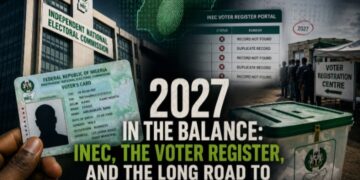
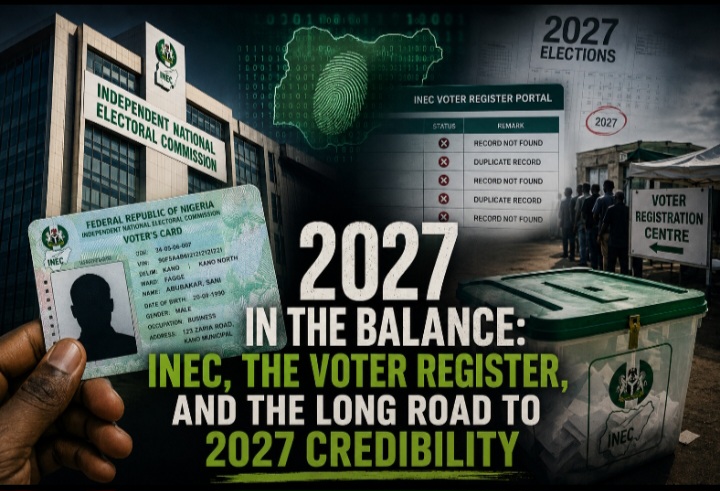
In recent weeks, Nigerians who participated in the 2023 general elections have taken to social and traditional media to report that they can no longer find their records on the INEC portal, especially when attempting to transfer polling units or check their voting status ahead of 2027. Alongside these complaints are separate reports of duplicate registrations appearing under the same names.
On their own, database errors can occur in any large biometric system during migration, upgrades, or deduplication. But in a political environment already marked by low trust, technical anomalies are quickly interpreted as signs of manipulation. The distinction between a glitch and a plot is now paper-thin in the public mind, and that perception is itself a threat to the 2027 process.
Data Security and Public Confidence
The anxiety has been compounded by a separate controversy around voter data security. Media reports have circulated alleging that the private registration details of a prominent opposition figure were obtained and leaked, with the source traced not to external hacking but to internal handling.
INEC has been quoted as clarifying that its systems were not breached by outsiders, yet that clarification has unsettled many observers. Cybersecurity professionals consistently rank insider risk as one of the most difficult vulnerabilities to manage because it bypasses firewalls and exploits legitimate access.
If voter data can leave the Commission through internal channels, the question becomes less about code and more about controls, audit trails, and consequences.
Nigerians are therefore looking for more than assurances. They are asking for evidence of robust access management, routine audits by the Nigeria Data Protection Commission (NDPC), and public disclosure of remedial steps. Without that, the neutrality of the umpire remains an open question in the minds of citizens and political actors alike.
The Perception of Neutrality
Perception of neutrality is also shaped by the conduct and history of leadership.
Early this year, screenshots purportedly from an old social media account linked to the INEC Chairman, Prof. Joash Amupitan SAN, were widely circulated online, with contents critics described as partisan.
The authenticity, context, and timing of such materials are often disputed, and institutions typically avoid commenting on historical personal digital content. Nevertheless, the episode highlights a broader challenge faced by election management bodies worldwide: impartiality must not only be practiced but must also be seen to be practiced.
Many electoral commissions globally maintain codes of conduct covering public expression, disclosure obligations, and recusal standards where perceptions of bias may arise. INEC’s ability to inspire confidence will depend partly on whether it institutionalizes such standards and communicates them clearly.
The Cost of Credibility
All of this is unfolding against the backdrop of significant public expenditure.
The National Assembly has appropriated over one trillion naira for 2027 election preparations, covering logistics, technology, personnel, and security. Citizens and civil society groups are understandably asking whether that investment will produce a credible outcome.
The voter register is the first place where value for money must become visible. When substantial funds are committed to biometric devices, server upgrades, and the Automated Biometric Identification System (ABIS), the public expects fewer missing records and fewer duplicates—not more.
International and domestic election observers have repeatedly recommended greater transparency regarding voter register management, technology deployment, and data verification processes. Adopting such recommendations would help align expenditure with public trust.
The Continuous Voter Registration Challenge
The ongoing Continuous Voter Registration (CVR) exercise has become another flashpoint.
INEC announced that the current CVR phase will end on July 10, describing it as the final registration window before the 2027 elections. While deadlines are a necessary part of election administration, concerns have emerged regarding accessibility within the registration period itself.
Reports from several states describe long queues, slow processing times, and operational bottlenecks that leave applicants waiting for hours before completing registration.
Civil society observers warn that if the pace does not improve, eligible citizens—particularly in rural communities and densely populated urban centers—may be unintentionally excluded from the electoral process.
The Electoral Act provides the Commission with discretion to extend registration where necessary. Whether INEC exercises that discretion, and how it explains its decision, will shape public perceptions of fairness and inclusion.
The Institutional Question
Discussions about electoral credibility should remain rooted in verifiable facts and institutional accountability.
Where allegations arise against specific individuals, the responsible democratic response is investigation through the appropriate constitutional channels rather than the acceptance of unverified claims as established truth.
The central question is not ultimately about personalities. It is whether INEC possesses the systems, transparency, and enforcement mechanisms required to protect itself from interference, error, and abuse regardless of who occupies leadership positions.
A Roadmap to Restoring Confidence
The path to restoring confidence is narrow but achievable, and it begins with the voter register itself.
First, INEC should commission an independent audit of the voter register and the ABIS process, with clear terms of reference released publicly. Such an audit should examine records across all geopolitical zones, assess transfer anomalies, and quantify any remaining duplicate registrations.
Second, the Commission should publish real-time CVR metrics, including machine deployment statistics, registration rates, downtime incidents, and response times. Transparency reduces speculation and allows citizens to evaluate performance objectively.
Third, INEC should work closely with the Nigeria Data Protection Commission to conduct privileged-access reviews and strengthen controls surrounding voter data management. Every export, modification, or transfer of sensitive voter information should be fully traceable.
Fourth, the Commission should clearly communicate its plans regarding the post-registration period. Whether the July 10 deadline remains fixed or extensions become necessary, citizens deserve timely explanations grounded in law and operational realities.
Fifth, INEC should review and publicize its code of conduct for electoral commissioners and senior officials, including standards governing social media activity, conflict-of-interest disclosures, and recusal procedures.
Neutrality is not merely an expectation; it is a practice that must be documented, taught, monitored, and enforced.
The Role of Civil Society, Political Parties and the Media
Electoral credibility cannot be sustained by INEC alone.
Civil society organizations must intensify voter education efforts focused on registration verification, polling unit transfers, and complaint resolution mechanisms.
Political parties should prioritize evidence-based engagement with electoral processes, relying on administrative and legal remedies where concerns arise rather than speculation.
The media also carries a significant responsibility. Accurate reporting requires distinguishing between verified breaches and untested allegations. Public confidence suffers when speculation is reported as fact.
The Real Danger Ahead of 2027
The greatest risk facing Nigeria ahead of 2027 is not the inability to conduct an election. The country has organized multiple elections under difficult conditions since 1999.
The greater danger is that a critical mass of citizens may come to believe that outcomes are predetermined before the first ballot is cast.
Once that belief takes hold, logistical improvements alone may not restore legitimacy.
The voter register is where confidence begins. If citizens who voted in 2023 struggle to locate their records in 2026, trust in the next election becomes harder to sustain. If duplicate registrations remain unresolved, election outcomes become more vulnerable to dispute. If voter data is perceived as insecure, institutional credibility suffers further.
INEC still has time to change the trajectory. The Commission can demonstrate corrective transparency by openly addressing concerns, acknowledging shortcomings where they exist, and implementing reforms in full public view.
It can show that administrative deadlines are accompanied by adequate capacity. It can demonstrate that insider risks are taken seriously through transparent investigations and sanctions where necessary. Most importantly, it can reinforce the principle that elections are governed by law rather than personal discretion.
Conclusion
Nigerians are not demanding a perfect voter register. No democracy has achieved that standard.
What citizens seek is a register that is accountable, transparent, and responsive. They want to find their names when they search. They want errors corrected promptly. They want assurance that voter information is protected from misuse.
Provide that, and 2027 will become a contest of parties, policies, and ideas.
Fail at it, and 2027 risks becoming a contest over the referee rather than the future of the nation.
The Commission’s task is therefore not to win a public relations battle. It is to rebuild procedural legitimacy one record, one audit, and one disclosure at a time.
The countdown to 2027 is already underway, and trust, once lost, remains the most expensive asset to recover.
Kenneth Eze is a Public Affairs Analyst writing from Abuja, Nigeria.
Email: engrchukeze2014@gmail.com